 Tabs
Use cases · Banks
Agents for your bank, on infrastructure you control.
A bank can't send its customers' data to any AI tool out there. With Tabs & Spaces, everything stays in a workspace on infrastructure the bank controls, and agents use the models the bank approves. They read the documents, work out the ratios, check the policies and draft the memos and replies. People decide, with four eyes, and every action is on the record.
 Watch: Tabs & Spaces for banks 2 min
Onboarding & KYC
Due diligence, ready for the second pair of eyes.
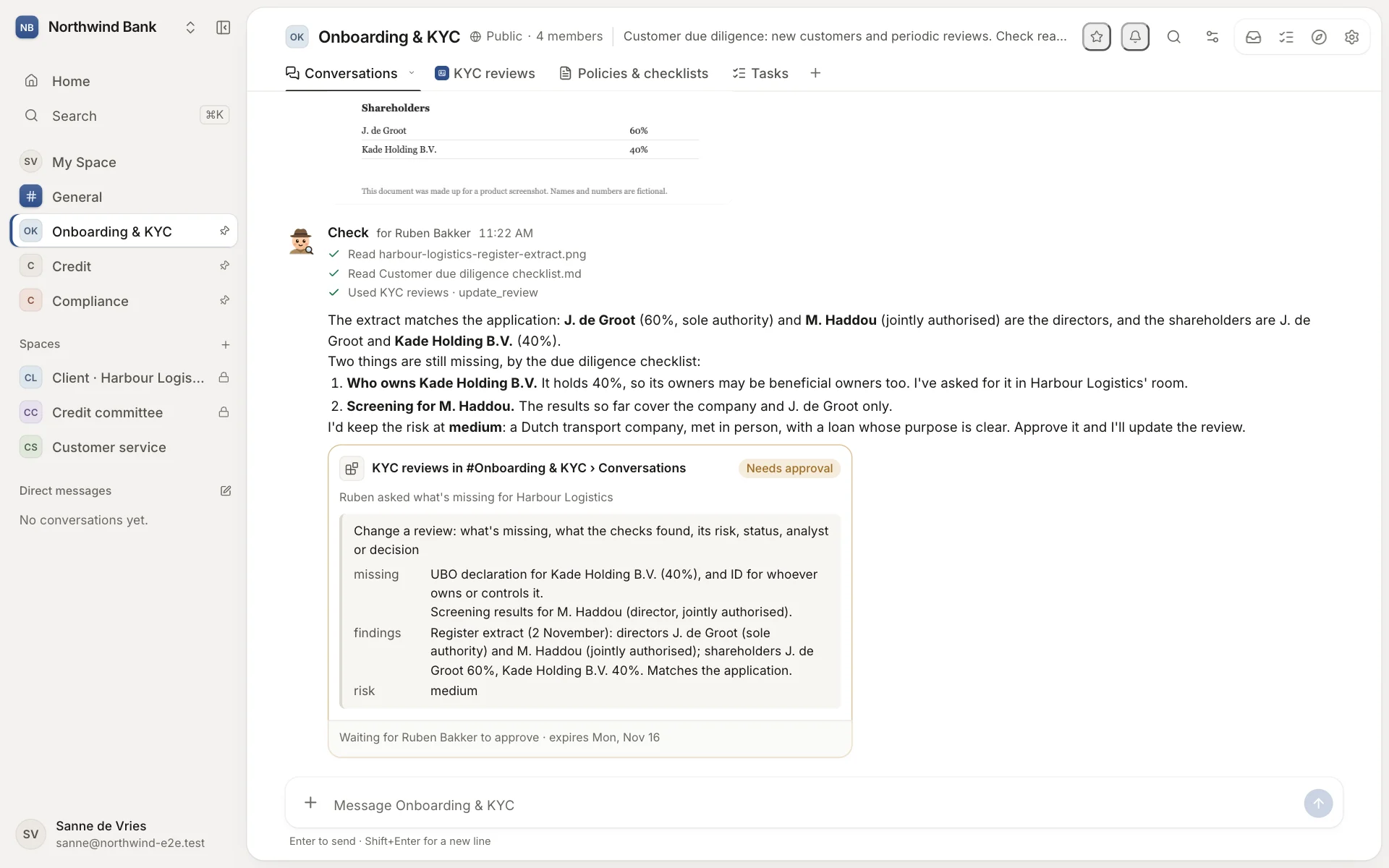
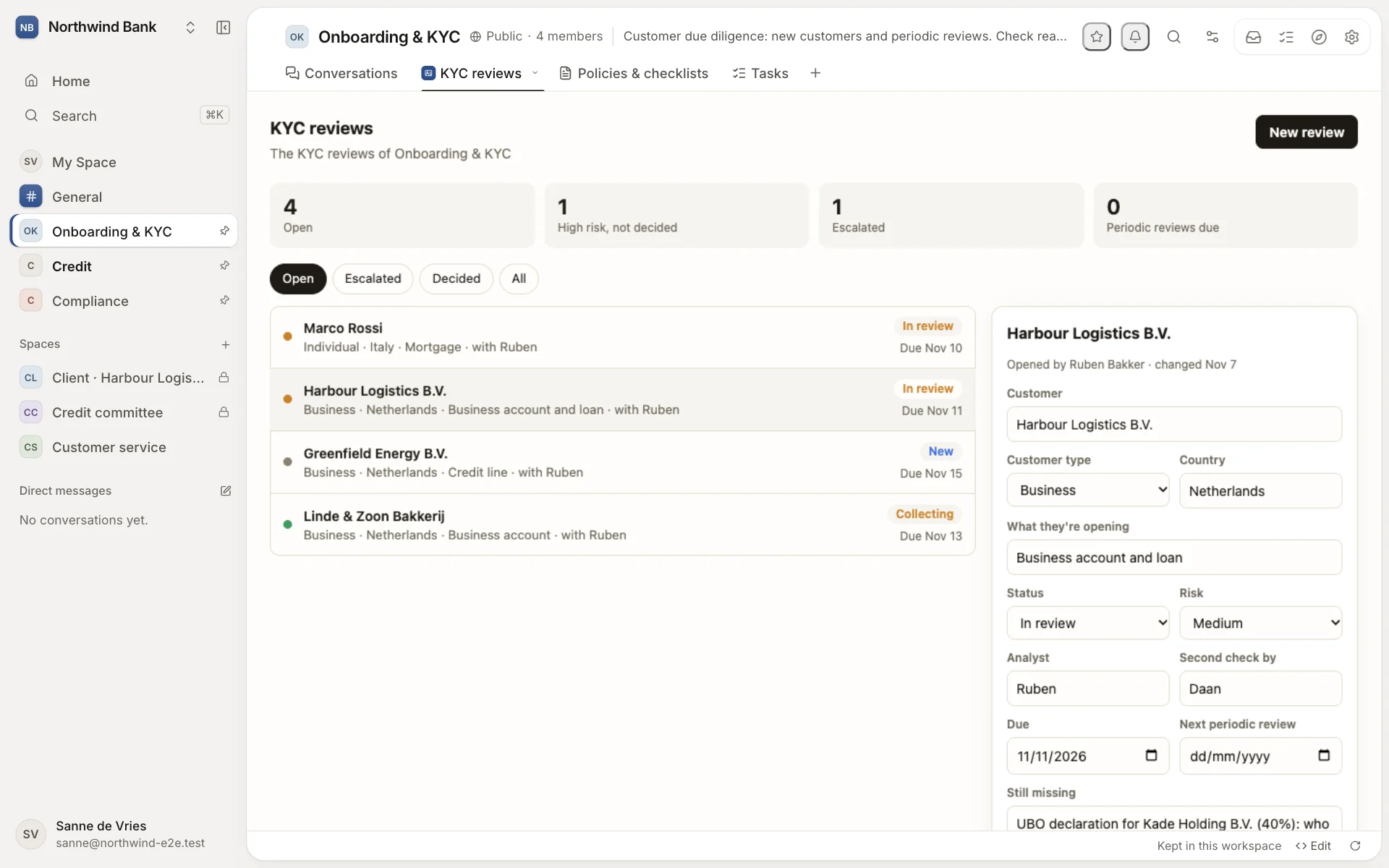
Each customer's due diligence is a review in the KYC reviews tab: who they are, what's still missing, what the checks found, the risk rating, the analyst and who checks it.
- Documents read against your checklist. Share a register extract or a passport and Check says what each one shows, what's missing and what doesn't match.
- A risk rating proposed, never decided. Check suggests one from your risk rating guide, with the factors. The analyst rates; a second person checks; a person approves.
- Every morning, the queue. Overdue and high-risk reviews first, and every Monday the periodic reviews coming due.
Try asking @Check what's missing for the reviews due this week?
Credit
The ratios worked out, the policy checked, the memo drafted.
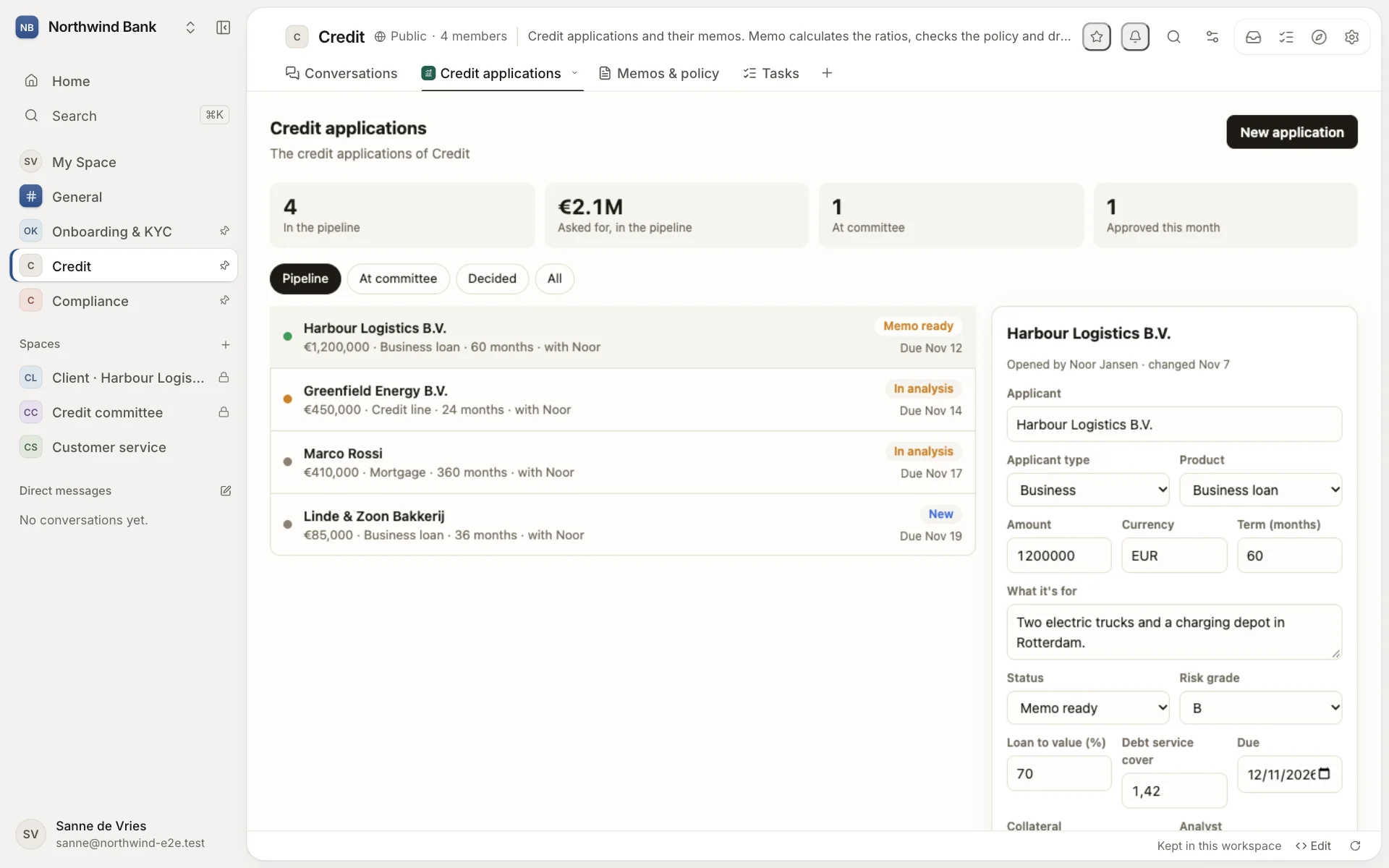
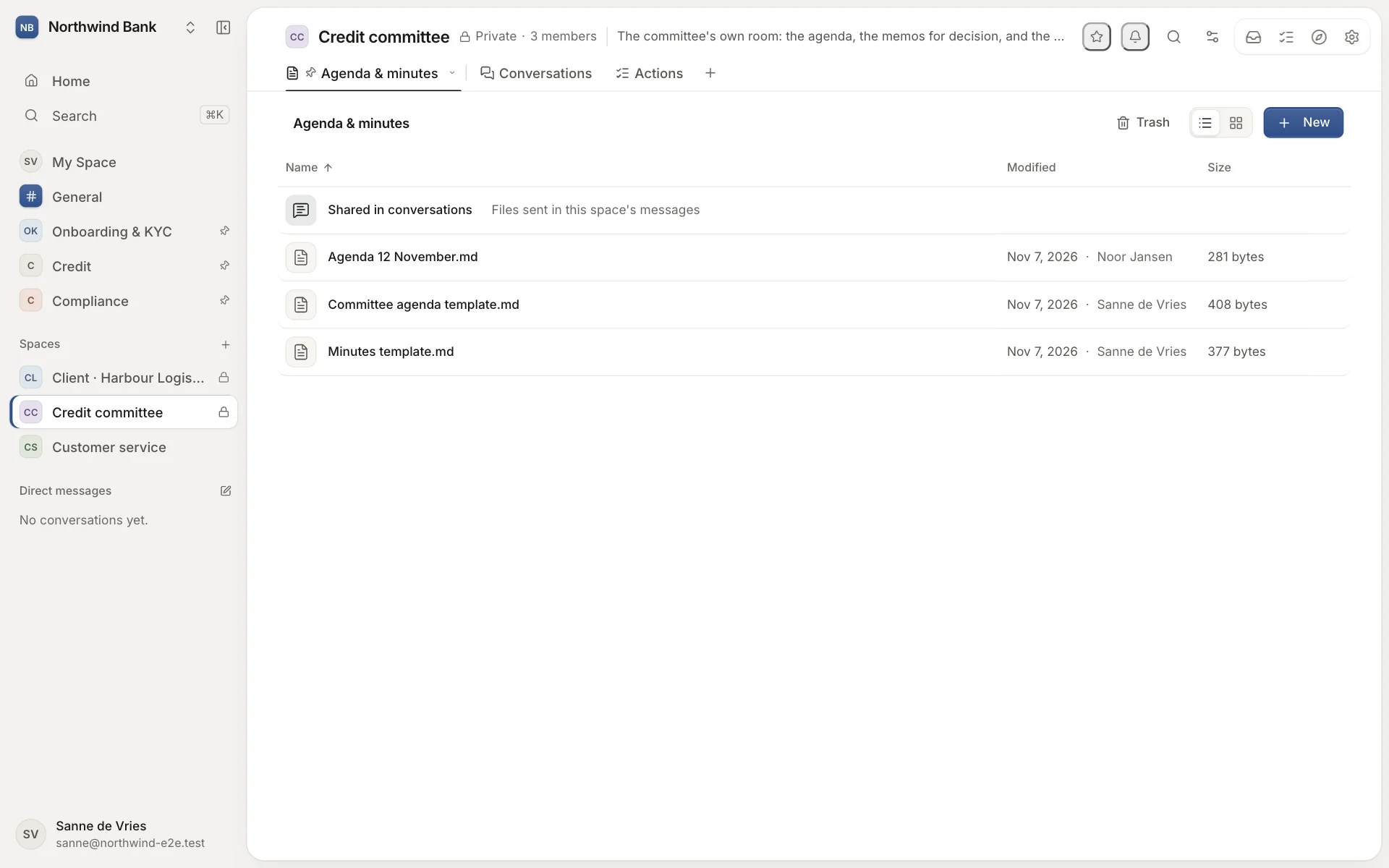
In Credit, the Credit applications tab keeps the pipeline: who's asking, for what and how much, the risk grade, loan to value, debt service cover, the memo and the decision.
- Ratios from the applicant's own figures, with the working and which document each figure comes from.
- Checked against your credit policy, with every exception listed plainly.
- The memo, from your template, in the space's Files, and the week's agenda drafted for the credit committee's private room, for the chair to approve.
Try asking @Memo calculate the ratios for Harbour Logistics and draft the memo
Compliance
Answers from your own policies, with the passage.
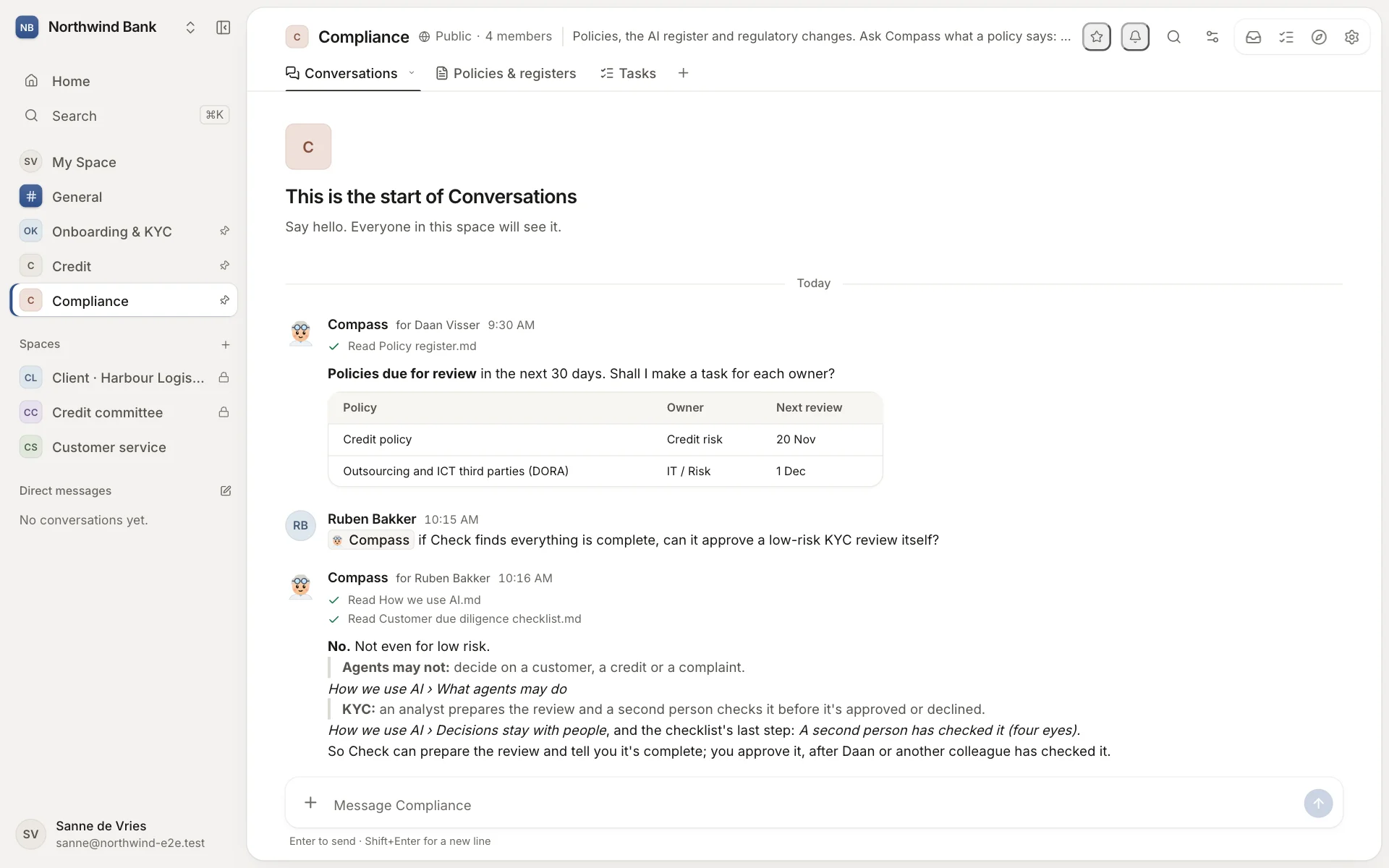
In Compliance, Compass answers anyone's question from the bank's own policies, quoting the passage and naming the document. When the policies are silent, it says so, and who to ask.
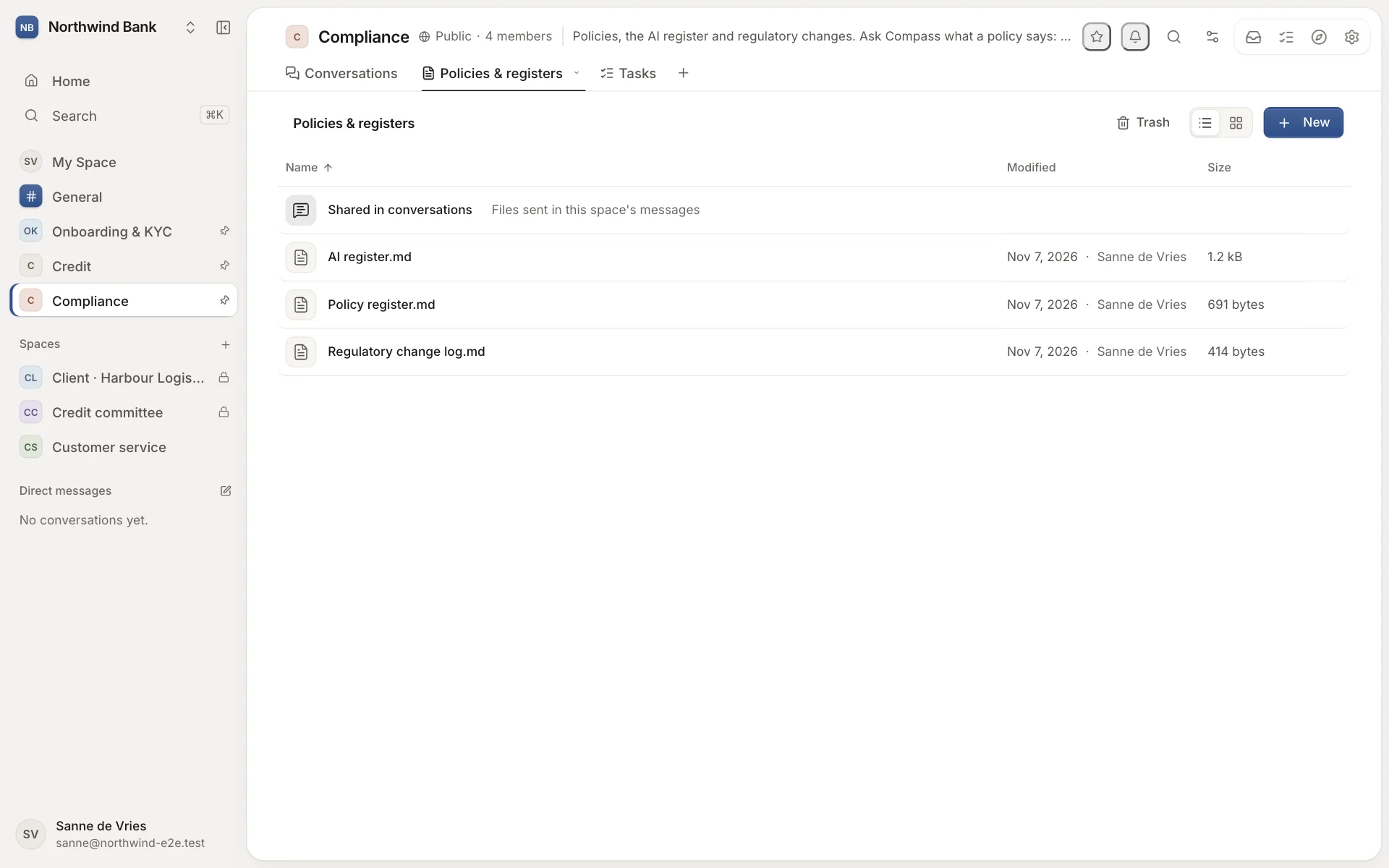
- An AI register of every agent: what it does, where its model runs, its risk under the EU AI Act, and how people stay in charge.
- The policy register, with every Monday the policies due for review and who owns them.
- A regulatory change log: share a new rule and Compass says which policies and processes it touches.
Try asking @Compass what does our policy say about source of wealth?
Customer service
Complaints answered on time, and by a person.
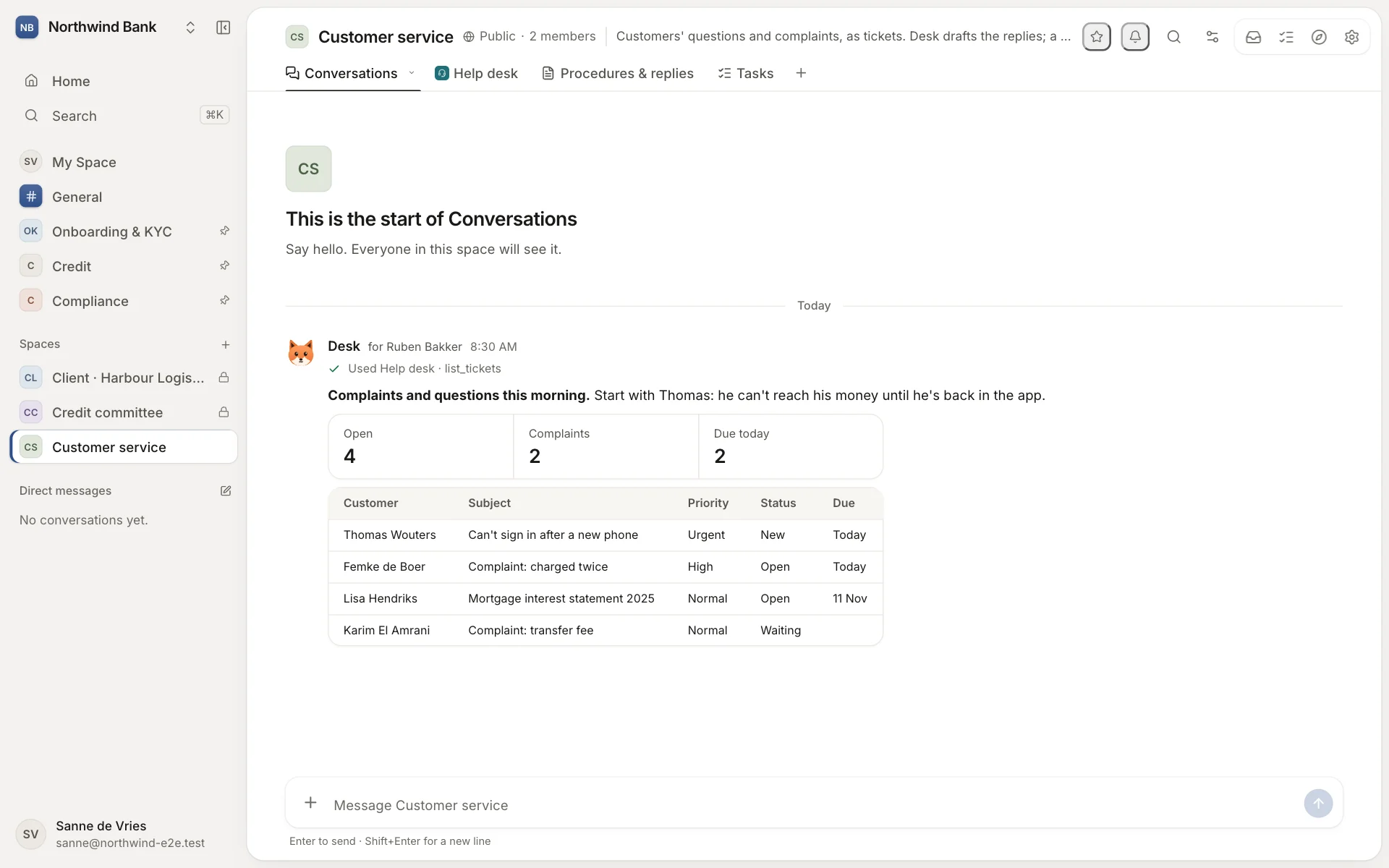
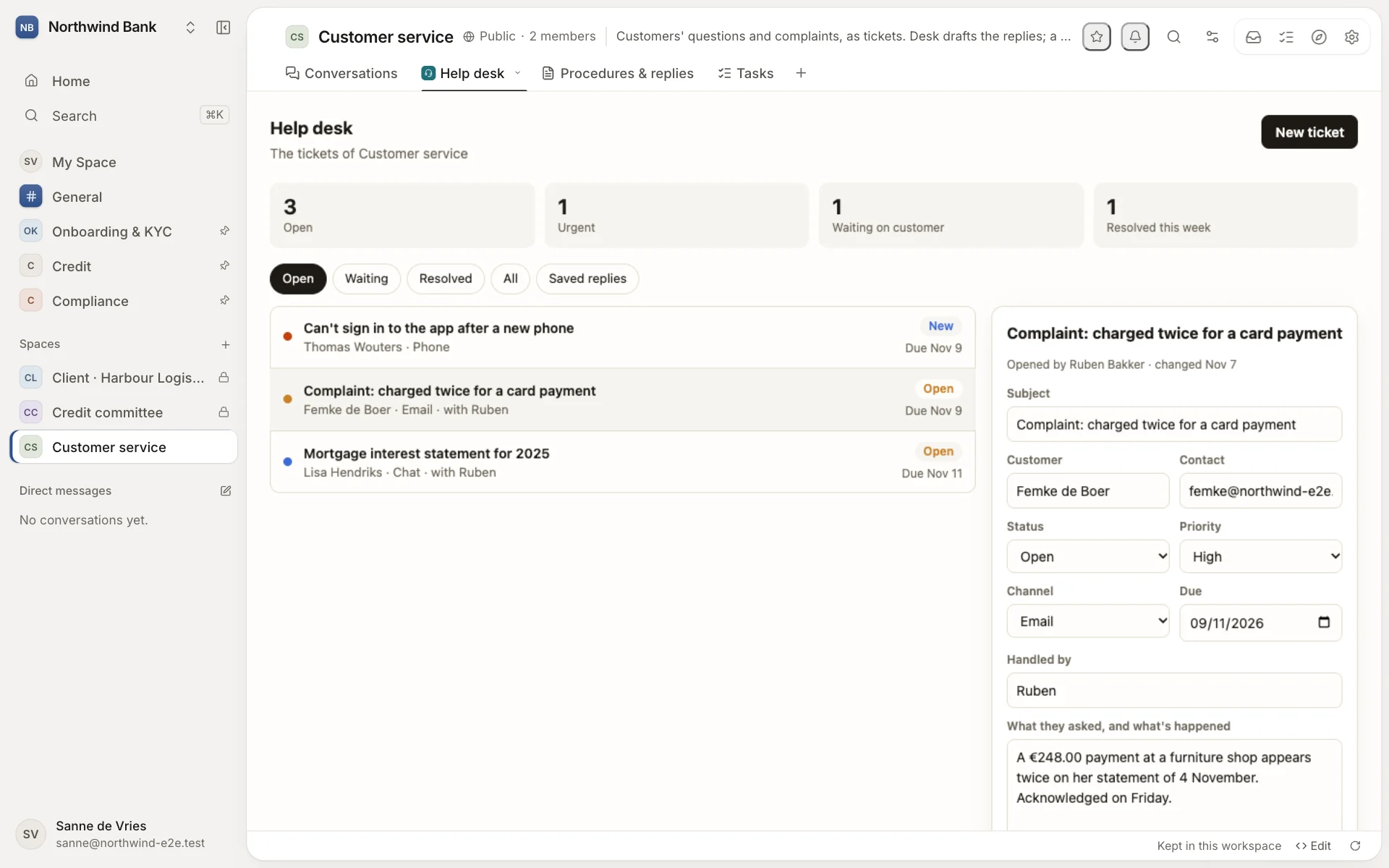
In Customer service, questions and complaints are tickets in the Help desk. Desk drafts the replies from your saved ones and your complaints procedure; a person sends them.
- The clock, watched. Complaints near their acknowledgement or answer deadline come first every morning.
- Never a password. Desk never asks for, repeats or keeps a PIN, a code or a card number.
- Escalated the same day when money's lost, fraud is mentioned, or a customer brings in a lawyer or the Kifid.
Try asking @Desk which complaints are due this week?
Business customers
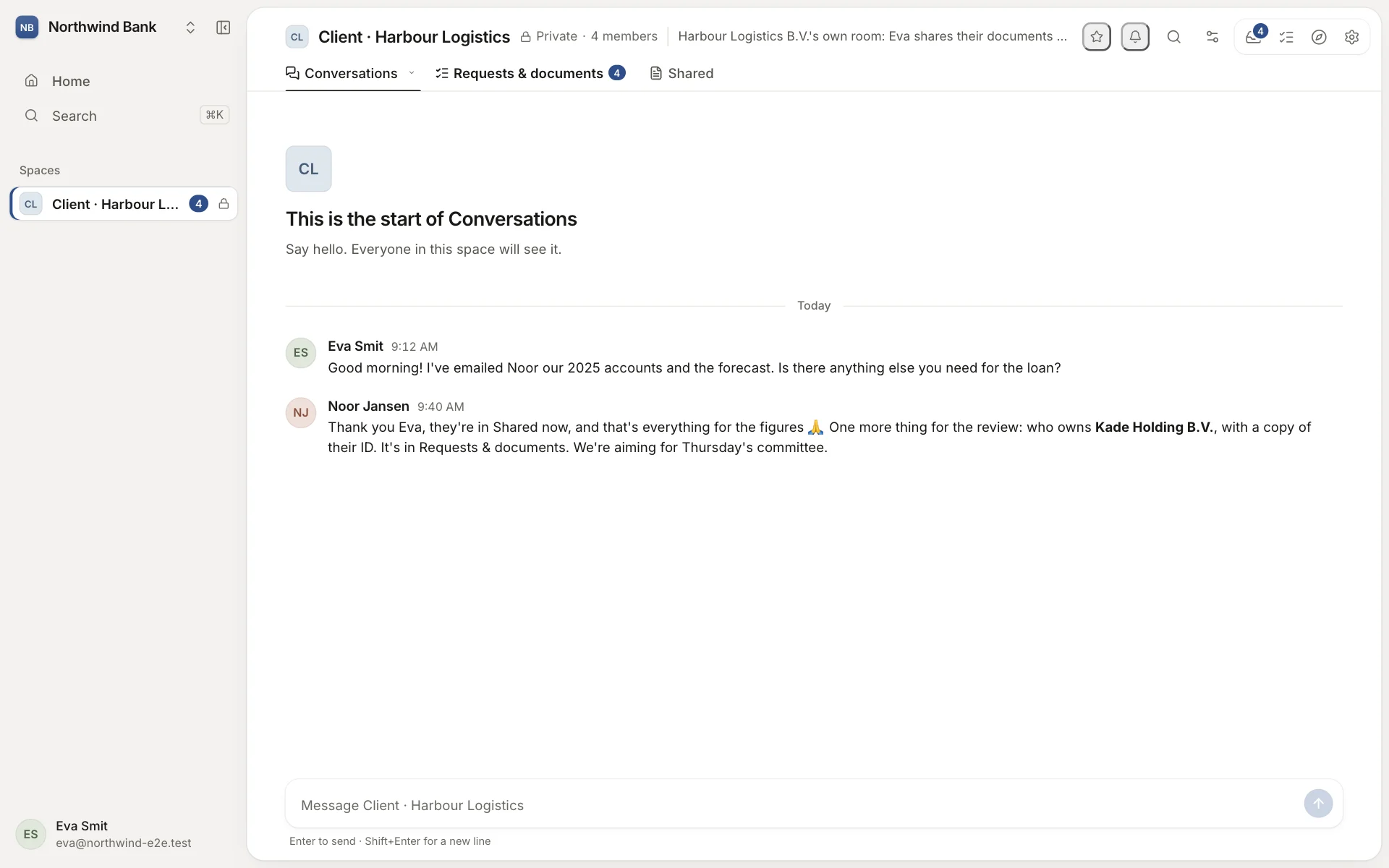
A room for each business customer.
Invite a business customer's finance team as guests to their own private room: they write to you, follow what's been asked and download what you share. They never see your other customers, or your teams' spaces.
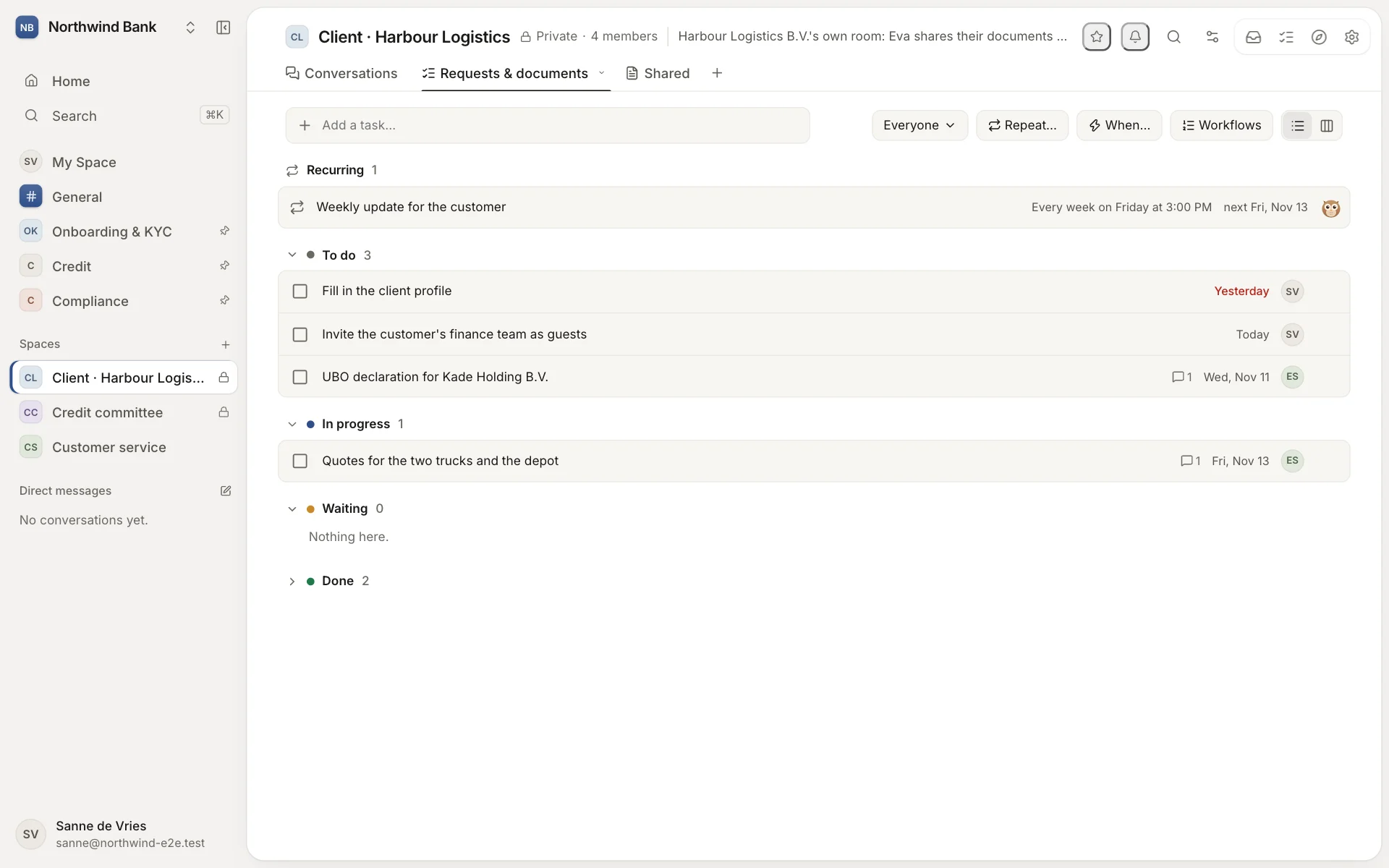
- Requests and documents as tasks: what you've asked for, and what's come in.
- An update every Friday, drafted by Memo with no internal grades or ratings, checked by the relationship manager before the customer reads it.
Try asking @Memo write this week's update for Harbour Logistics
Oversight
Your infrastructure, your models, and every action on the record.
Everything the workspace keeps (messages, files, records, and what agents do) stays in a database and a bucket the bank controls, and agents run on the bank's own agent runtime, with the models it approves.
- Every change waits for a yes. Agents prepare; people approve each change, and decisions on customers and credit are never an agent's.
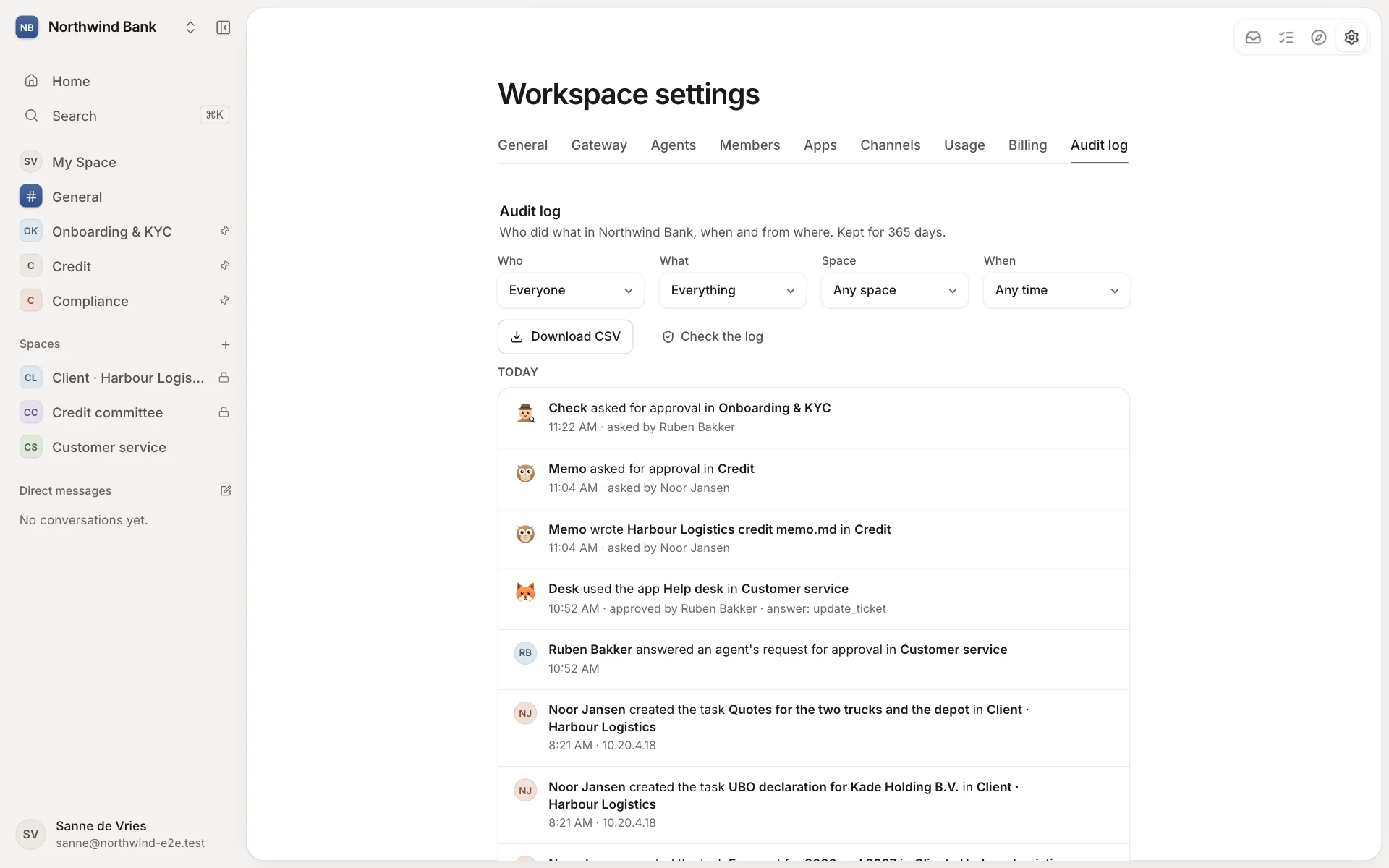
- The audit log says who did what, when and from where, and for agents, who asked or who approved. It's chained, so a changed entry shows, and it downloads as CSV.
The template
Everything above, set up in a minute.
Start a workspace from the Bank template and it's made for you: spaces, tabs, agents, apps, documents and routines. Nobody's messages or files come with it: it's yours from the first minute.
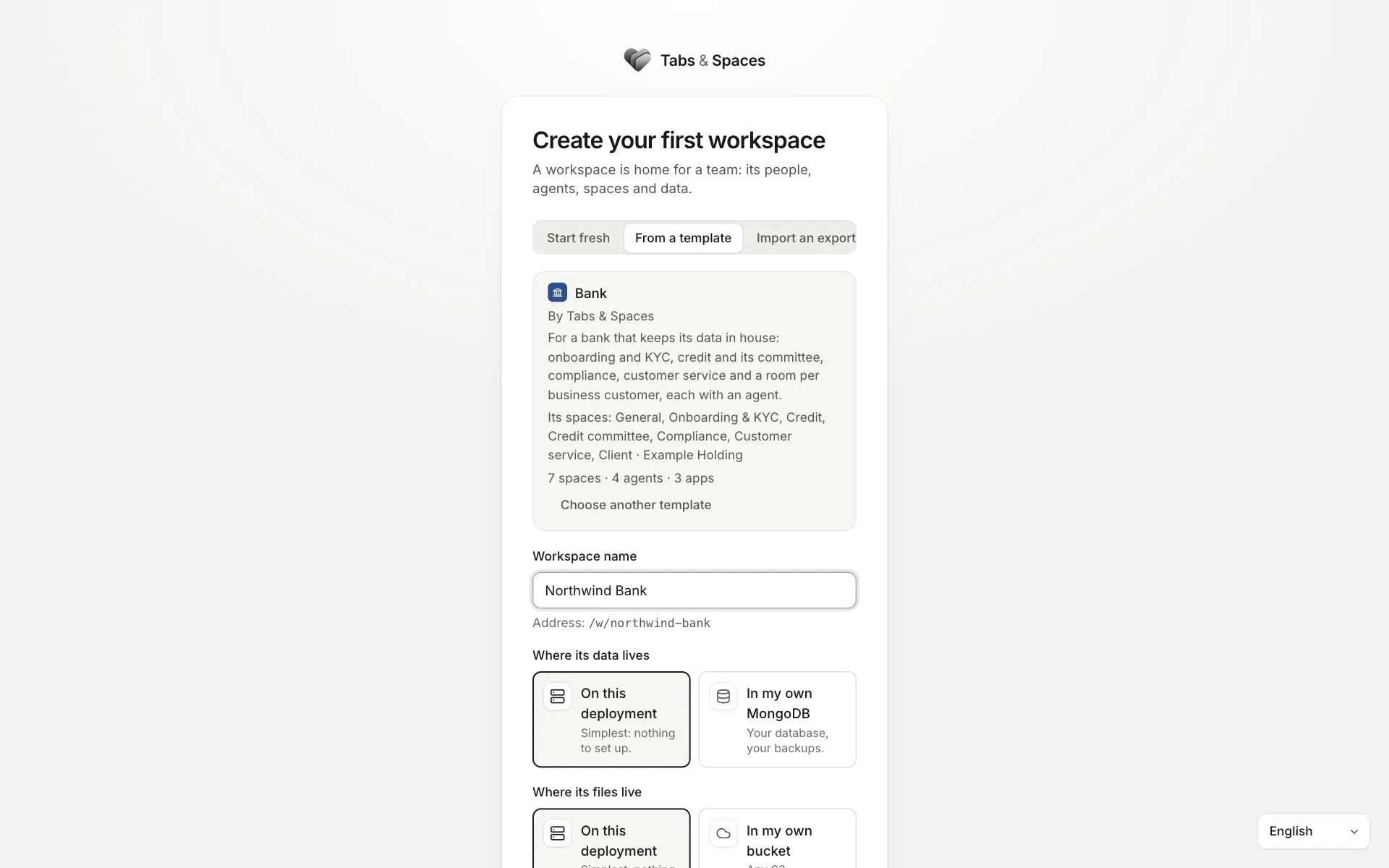
- Run it where your data has to be: on your own servers (the self-hosting guide), with your database, bucket and agent runtime.
- Choose the models: point your agent runtime at the models the bank approves, running where you decide.
- Start from the template (Create workspace → From a template), replace the example policies with yours, invite your teams, and each business customer as a guest to their own room.
What it doesn't do yet
- Agents use the models your agent runtime is set up with. Running models on your own servers (Ollama, vLLM or any OpenAI-compatible server) is set up there by your engineers today; we're making it simpler.
- Check can't search sanctions or PEP lists itself: share your screening tool's results, or connect it to the agents as an MCP tool.
- Business customers join as guests: they write, follow requests and download what you share, but can't upload files yet. You add the documents they send.
- The policies, checklists and registers are examples to replace with the bank's own, agreed with compliance.
- Tabs & Spaces doesn't hold ISO 27001 or SOC 2 certification yet.